
Banking sector assets up by 21.4% in 2025
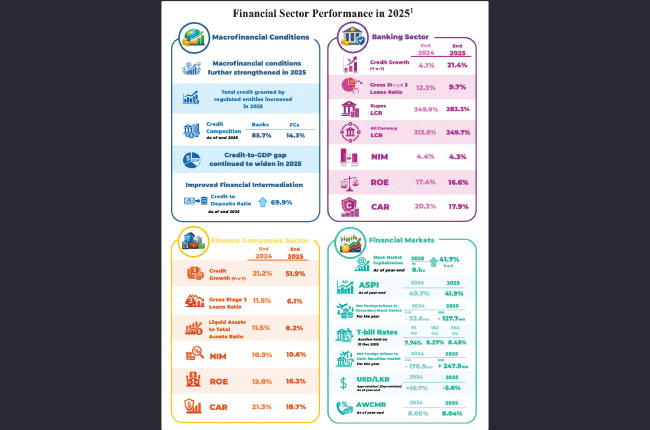
The financial sector in Sri Lanka has witnessed strong growth in 2025, with the profitability and lending growth of banks and financial institutions increasing, the Central Bank of Sri Lanka (CBSL) statistics revealed.
Accordingly, a number of key financial indicators have seen significant growth, and the stability of the banking and non-banking financial institutions system in particular has been further confirmed, the Central Bank sources said. Total assets of the banking sector have grown by 21.4% in 2025, a significant increase compared to the 4.1% growth recorded in 2024. This expansion has been driven by loans provided to multiple economic sectors including financial services, trade, consumption, construction and manufacturing.
In particular, loans provided to the financial services sector have recorded a rapid growth of 148.0%. In terms of credit quality, the banking sector’s Stage 3 loan ratio has declined from 12.3% in 2024 to 9.7% by the end of 2025, the first time since 2022 that the ratio has reached single digits. The banking sector has also demonstrated its strong profitability by achieving a return on equity (ROE) of 16.6% in 2025.
The finance companies sector has also shown remarkable progress in 2025. The growth in gross loans and advances in this sector has increased from 21.2% in 2024 to a rapid 51.9% by the end of 2025. This has been mainly driven by auto loans (growth of 52.7%) and loans against gold (growth of 63.8%). The profit after tax of financial companies also recorded a significant growth of 45.0% to Rs. 61.5 billion.
The Colombo Stock Exchange also showed high performance during 2025. The All Share Price Index (ASPI) increased by 41.9% and the S&P Sri Lanka 20 (S&P SL20) index increased by 26.6%. The stock market capitalization also increased by 41.7%. However, in the foreign exchange market, the rupee depreciated by 5.6% in 2025, a reversal of the continuous appreciation of the rupee in 2023 and 2024.
Although the financial system remains robust, sources indicate that global volatility, including geopolitical conflicts in the Middle East, commodity price volatility, and adverse weather conditions could adversely affect the credit quality of the financial sector. Therefore, the Central Bank emphasizes that sustainable public financial management and strengthening foreign reserves are essential to safeguard the stability of the financial system. (DSA)
Source : Daily News



Recent Comments